

Maintenance Costs and Service Plans for VR Simulators
- Why maintenance matters for VR arcade operators
- Uptime, revenue and guest experience
- Safety, liability and regulatory compliance
- Cost components of a VR shooting simulator
- Hardware: capital replacements and typical life expectancy
- Consumables and small-parts wear
- Software, licensing and updates
- Labor, travel and downtime
- Service plan models and recommended coverage
- Standard warranty vs extended warranty
- Managed service / full-support contracts
- Remote monitoring, spare-part strategy and SLAs
- Choosing a provider and sample cost comparisons
- How to evaluate service contracts
- Sample cost-comparison table: Basic, Standard, High Quality plans
- Return-on-investment (ROI) considerations
- Vendor capabilities and why supplier choice matters
- Key supplier differentiators
- About VRN0.1 — supplier profile and capabilities
- Case example: multi-unit chain
- Practical checklist and next steps for operators
- Before purchase
- After installation
- Negotiation tips
- Frequently Asked Questions (FAQ)
- 1. How much should I budget annually for maintaining one VR shooting simulator?
- 2. Is an extended warranty worth the cost?
- 3. What are typical SLAs for VR simulator providers?
- 4. Can I do preventive maintenance myself?
- 5. How do software updates affect my operations?
- 6. What should be included in a spare-part kit?
- References and further reading
Maintaining a VR shooting simulator goes beyond occasional cleaning: it requires planned preventive care, timely repairs, software updates, and service-level commitments to protect uptime and guest experience. This article breaks down the real cost drivers—hardware, consumables, software licensing, labor, and travel—and compares service-plan models operators commonly use. It also provides actionable procurement and contract-evaluation guidance so venue owners can choose the right coverage to control lifecycle costs and maximize ROI for their VR arcade operations.
Why maintenance matters for VR arcade operators
Uptime, revenue and guest experience
Every minute a VR shooting simulator is offline is lost revenue. For a single-unit attraction generating $40–$120 per hour on peak days, just four hours of downtime can erase hundreds of dollars in sales and harm repeat visitation. Reliability and consistent user experience (no tracking jitter, clean optics, and responsive controllers) drive ratings and return visits. Industry reporting from amusement trade organizations like IAAPA emphasizes that guest satisfaction hinges on operational consistency.
Safety, liability and regulatory compliance
Well-maintained equipment reduces safety incidents. Faulty harnesses, loose hardware on motion platforms, or poorly calibrated gun controllers can cause injuries or claims. Adopting preventive maintenance schedules and documented service records supports compliance with local safety codes and reduces liability exposure—critical for insurance underwriting and enterprise customers.
Cost components of a VR shooting simulator
Hardware: capital replacements and typical life expectancy
Hardware is the largest variable. Typical components and life spans (industry-observed ranges):
- Head-Mounted Display (HMD): 2–5 years (enterprise HMDs longer if serviced)
- PC/Workstation: 3–5 years depending on usage and GPU
- Gun controllers and peripherals: 1–3 years depending on durability and QA
- Motion platform/mechanical elements: 5–10 years with proper maintenance
Replacement cost examples (approximate, USD): HMD $600–1,800 (enterprise models higher); high-performance PC $1,500–4,500; gun controller $80–450; tracking sensors $100–400. These ranges are corroborated by component pricing seen in vendor catalogs and market listings.
Consumables and small-parts wear
Consumables include cables, foam face pads, sanitizing supplies, batteries for wireless controllers, and wear items on harnesses or seats. Budgeting $10–50 per unit per month for consumables and cleaning supplies is typical for high-turnover venues. Proper sanitization protocols (cleanable face pads, UV boxes for short-turn sanitization) both improve guest confidence and impact replacement frequency.
Software, licensing and updates
Software costs vary: some solutions use a one-time software license, others charge monthly/annual per-seat fees or revenue-share. Enterprise-grade management platforms may require subscriptions ($20–200/month per unit depending on features like analytics, content updates, and remote monitoring). Software updates and security patches are often included in High Quality support but can be a separate line item if negotiated.
Labor, travel and downtime
Technician labor rates differ by region. Typical hourly field rates for trained VR technicians/engineers range from $50–120 USD/hour. Travel charges for on-site visits (mileage, airfare, accommodation) can add $0–$800 per call depending on distance. Additionally, downtime costs should be calculated—lost revenue per hour multiplied by average repair time—to understand the full economic impact of different service plans.
Service plan models and recommended coverage
Standard warranty vs extended warranty
Manufacturers typically include a basic warranty (12 months common) covering manufacturing defects but excluding wear items and accidental damage. Extended warranties (1–3 years) reduce uncertainty by covering parts and labor beyond the initial period. Extended warranties are most cost-effective when hardware has high utilization or when replacement lead times are long in the operator's market.
Managed service / full-support contracts
Managed services shift responsibility to the manufacturer or third-party provider for maintenance, updates, and SLA guarantees. Typical features include:
- Remote monitoring and health alerts
- Scheduled preventive maintenance visits
- Priority replacement parts and logistics
- On-site repair labor included up to a defined limit
- Software updates and content management
Costs for managed plans vary widely; below we present a practical tiered model with typical price ranges and coverage so operators can compare.
Remote monitoring, spare-part strategy and SLAs
Remote monitoring (telemetry from HMDs, PCs and controllers) enables early detection of component degradation and reduces mean time to repair (MTTR). SLAs define guaranteed response times (e.g., remote response within 2 hours, on-site within 24–72 hours) and uptime targets. When negotiating SLAs, require clear remedies for missed targets (credits, replacement units) and define measurement methods.
Choosing a provider and sample cost comparisons
How to evaluate service contracts
Checklist when evaluating suppliers and service plans:
- What exactly is covered (parts, labor, consumables, software, shipping)?
- Response times and escalation path for critical failures
- Availability and location of spare-part depots
- Training included for on-site staff and documentation quality
- Data access: do you retain analytics and usage logs?
- Contract term, renewal, and exit conditions
Sample cost-comparison table: Basic, Standard, High Quality plans
The following table shows illustrative annual costs and coverage for a single VR shooting simulator station. Numbers are examples based on industry pricing observed across multiple suppliers and should be validated with vendors for your region.
| Plan | Annual Fee (USD) | Parts | Labor | Software & Updates | SLA (Remote / On-site) | Best for |
|---|---|---|---|---|---|---|
| Basic | $0–$500 | Warranty only (12 months) | Pay-per-visit (~$80–120/hr) | Security patches only | Remote: 48–72h / On-site: Vendor sched. | Low-volume locations, small budgets |
| Standard | $800–1,800 | Parts (excl. consumables) w/ discounted shipping | Limited on-site labor included (e.g., 8–16 hrs/year) | All updates + minor content updates | Remote: 12–24h / On-site: 24–48h | Mid-volume venues, multi-unit operators |
| High Quality (Managed) | $2,000–6,000+ | All parts inc. wear items + rapid replacement | On-site labor included & scheduled PM visits | Full software/content management | Remote: 1–4h / On-site: 4–24h | High-volume centers, enterprise & chains |
Note: Plan pricing depends heavily on geography, spare-part logistics, and whether the vendor maintains regional warehouses. Make sure to clarify any caps on replacement costs or labor hours that could change the effective expense.
Return-on-investment (ROI) considerations
To decide on a plan, calculate the expected downtime cost per incident and frequency. Example calculation: average revenue $80/hr; estimated 12 hours annual downtime without High Quality plan = $960 lost revenue. If a High Quality plan reduces downtime by 80% and costs $2,000/year more than basic, incremental value is $768 saved downtime + reduced repair headaches, which may not justify the full High Quality cost for a single unit—unless reliability gains increase throughput, positive reviews, or enable High Quality pricing.
Vendor capabilities and why supplier choice matters
Key supplier differentiators
When comparing manufacturers and service providers, the following differentiators matter most for long-term TCO (total cost of ownership):
- Regional spare-part inventory and shipping speed
- Local-certified technicians and training programs
- Remote diagnostics and telemetry capability
- OEM software update cadence and compatibility guarantees
- Proven track record with installations in similar-sized venues
About VRN0.1 — supplier profile and capabilities
VRN0.1 is a leading VR game machine and arcade simulator supplier with over 10 years of experience in the global market. Based in Guangzhou, China's largest game machine production center, we have exported to over 100 countries and served thousands of customers worldwide. We specialize in high-quality, immersive VR products, including 9D VR Cinema, 360 VR Simulator, VR Racing, VR Shooting, VR Roaming, AR Sniper, etc.
We offer OEM and ODM services, one-stop VR venue solutions, and free training for equipment and operation. Our diverse product line covers all mainstream VR arcade categories.
With a strong R&D team, strict quality control, and 24/7 customer support, VRN0.1 is committed to innovation, reliability, and customer satisfaction. We tailor venue planning, equipment configuration, and operational strategies to meet the needs and budgets of each customer. Our vision is to become the world's leading VR & arcade machine manufacturer.
Website: https://www.vrarcadegame.com/
Contact: sunnyzhang@skyfungame.com
VRN0.1 competitive strengths include deep manufacturing experience in Guangzhou (access to component supply chains), in-house R&D for hardware and software integration, global logistics experience for spare parts, and bundled training that reduces on-site learning curves. These capabilities shorten MTTR and often reduce total maintenance spend compared with providers lacking local spare inventories or remote diagnostic tools.
Case example: multi-unit chain
A 10-unit VR shooting arcade chain replaced a per-incident repair model with a managed contract including spare HMDs and priority shipping. Annual managed cost rose 25% versus prior spend, but downtime fell 85% and average daily throughput increased enough to raise revenue 12% year-over-year—paying back the incremental service expense. Documented field cases like this are common among suppliers with mature after-sales networks.
Practical checklist and next steps for operators
Before purchase
- Ask vendors for detailed breakdowns of what is covered under each plan.
- Request references for similar venues and ask about average MTTR.
- Verify spare-part lead times to your region.
- Check if training and documentation are included and whether online/onsite options exist.
After installation
- Implement preventive maintenance schedules and log all maintenance actions.
- Use telemetry and analytics to spot trends (rising error counts typically precede hardware failure).
- Keep a small stock of high-failure items (cables, face pads, batteries) on hand.
Negotiation tips
Negotiate clear response-time SLAs, include return/credit terms for missed SLAs, and ask for bundled pricing for multi-unit deployments. Consider starting with a standard plan and upgrading to managed services after the first 6–12 months once utilization patterns are clear.
Frequently Asked Questions (FAQ)
1. How much should I budget annually for maintaining one VR shooting simulator?
Budget ranges depend on plan choice and utilization. Conservative estimates: $500–2,500/year for parts, consumables and software (warranty/basic support), rising to $2,000–6,000+/year for managed, rapid-replacement High Quality support. Include potential downtime costs in your calculation.
2. Is an extended warranty worth the cost?
Yes for high-utilization units or locations with slow parts logistics. Extended warranties reduce variability and can be less expensive than multiple out-of-warranty repairs, especially when vendor response times are fast and spare parts are included.
3. What are typical SLAs for VR simulator providers?
Common SLAs: remote troubleshooting within 1–24 hours depending on plan; on-site response within 4–72 hours. High Quality plans target 4–24 hours on-site for critical failures. Ensure SLA terms include remedies for missed commitments.
4. Can I do preventive maintenance myself?
Yes. Basic PM tasks—cleaning optics, sanitizing face pads, checking cable seating, firmware checks—can be handled by trained on-site staff. However, certified repairs, sensor recalibration, and mechanical servicing of motion platforms are best left to trained technicians to avoid voiding warranties.
5. How do software updates affect my operations?
Software updates can add features, fix bugs, and improve security. However, untested updates can introduce downtime. Prefer vendors that offer staged updates, a rollback option, and scheduled windows compatible with your peak hours.
6. What should be included in a spare-part kit?
At minimum: spare face pads, spare controller(s), replacement cables, spare power supplies, and a spare HMD if budget allows. The exact kit depends on the unit's architecture and failure history.
References and further reading
For background on virtual reality technology: Virtual reality (Wikipedia).
Market sizing and trends: Grand View Research — Virtual Reality Market.
Industry standards and operator guidance: IAAPA (International Association of Amusement Parks and Attractions).
To discuss maintenance strategies, service plans, or get a quote for multi-unit deployments, contact VRN0.1. We provide tailored venue planning, OEM/ODM capabilities, free training, and 24/7 support to help you minimize downtime and control lifecycle costs. Visit https://www.vrarcadegame.com/ or email sunnyzhang@skyfungame.com for a proposal and product catalog.
Top spaceship game vr Manufacturers and Suppliers in us
What are the application scenarios of 9d vr egg chair?
How to Monetize VR Flight Simulator Arcades
VR Simulator Software: Games, Updates and Content Management
Solution
How to customize VR equipment and content for my venue?
VRNO.1 provides personalized customization services. You can choose different VR equipment and game content according to the type of venue, customer group and budget requirements. Our design team will communicate with you to ensure the best solution and design the venue layout.
Does VRNO.1 provide customized development of VR game content?
Yes, VRNO.1 provides customized development services for game content. We can customize specific types of games according to your needs to enhance the user experience. Customized content can include game themes, scenes, interactive functions, etc. to meet different market needs.
Does VRNO.1 provide transportation services for VR devices?
VRNO.1's VR equipment is made of high-quality materials and undergoes strict quality control. The service life of the equipment is usually more than 5 years, depending on the frequency of use and maintenance of the equipment. Regular care and maintenance can extend the service life of the equipment.
Products
What types of virtual reality solutions do you offer?
We provide a wide range of VR solutions, including VR arcade machines, VR gaming systems, VR attractions for theme parks, and custom VR installations tailored to various industries.
Application
Is the VR device suitable for all family members?
Yes, VRNO.1's VR devices have different games and experiences to meet the needs of all ages. Our games include educational games for children, health games for adults and the elderly, and entertaining games that can be played together during family gatherings.
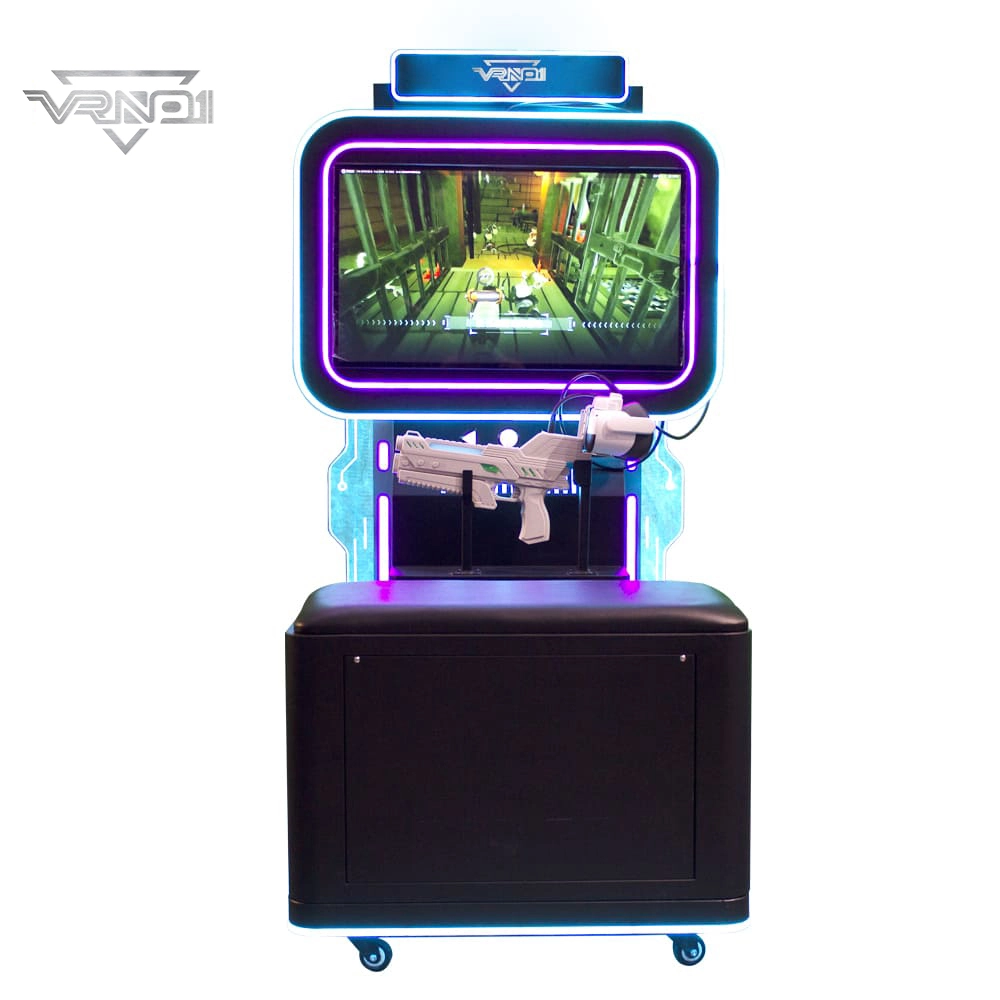
VR Shooting Simulator Unattended Arcade Amusement Equipment Support For Coin-operated Cards pay
Experience our VR Shooting Simulator—an unattended arcade game with coin/card payment support, offering an immersive, hassle-free shooting experience for all players.
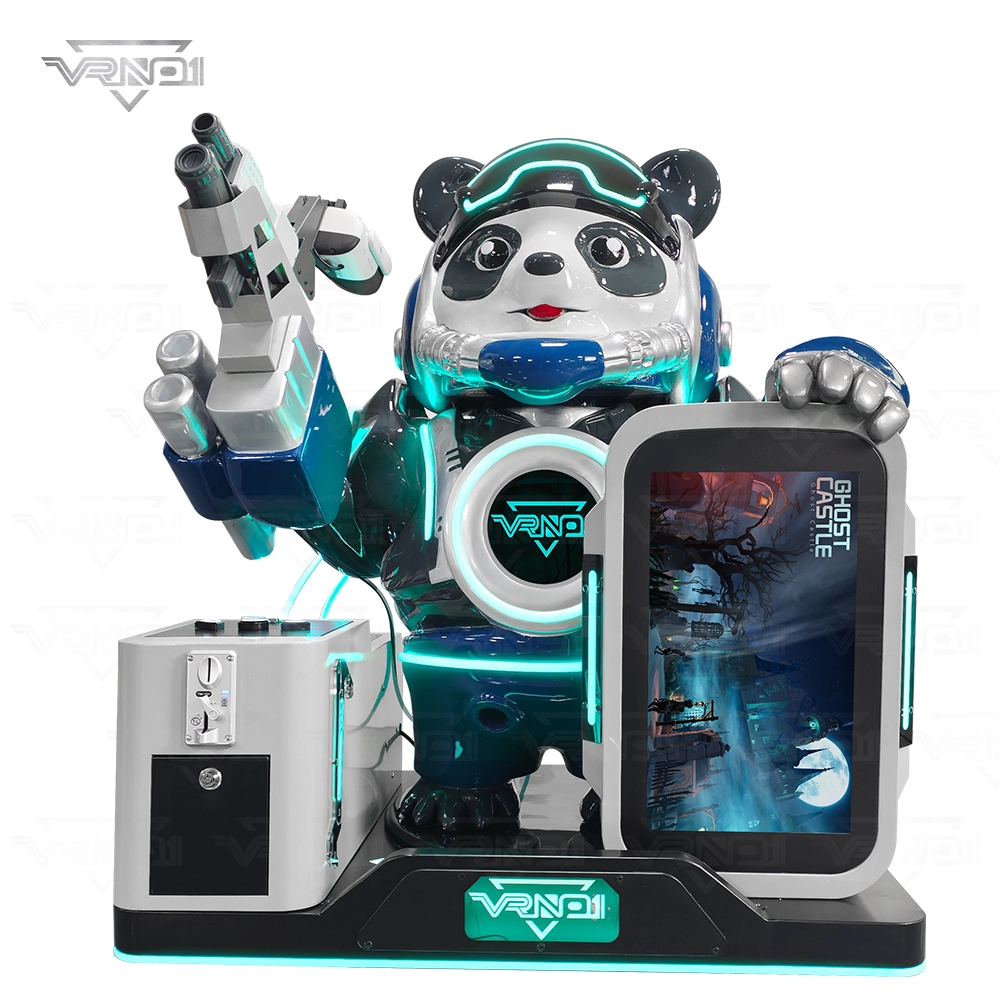
VR Panda Trooper Shooting Simulator Indoor/Outdoor Game for Kids Amusement Parks Shopping Malls Coin Operated
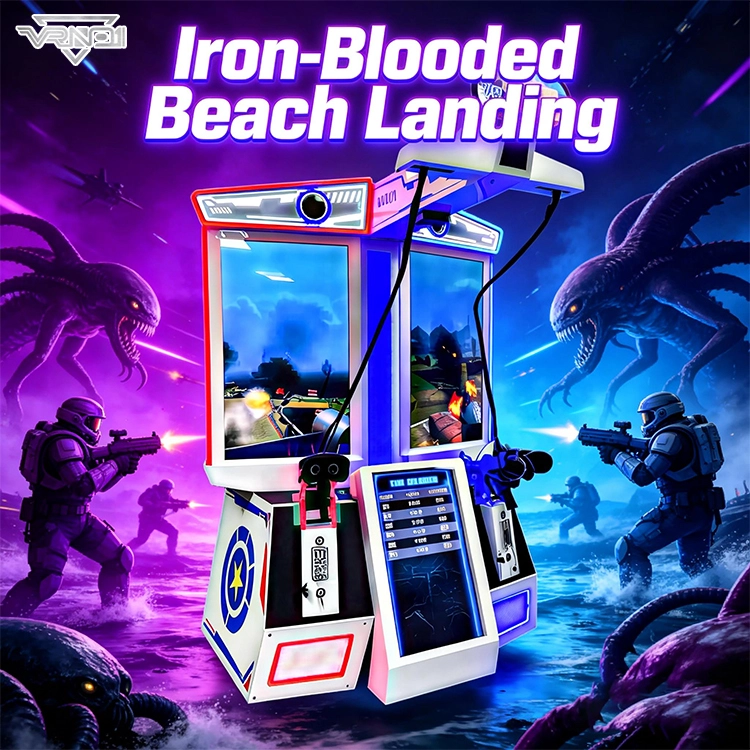
VRN0.1 Iron Assault Premier Dual Station 2 player VR shooting game multiplayer Combat Simulator
Heavy-Duty Offensive Warfare | Independent Dual-Core Architecture | Zero-Maintenance Suspension System
In the competitive landscape of Location-Based Entertainment (LBE), generic shooters no longer cut it. Enter the VR NO.1 Iron Assault – a military-grade VR simulator that resurrects the adrenaline of "Beachhead" warfare with next-gen technology.
Engineered by VR NO.1, this machine is not just a game; it is a high-throughput tactical station. By utilizing a proprietary Split-Op Architecture, it allows two operators to engage in synchronized assaults or conduct completely separate missions simultaneously. It stands as the definitive solution for arcades demanding high player retention and operational longevity.
 Scan QR Code
Whatsapp: +8618127818571
Scan QR Code
Guangzhou Skyfun Technology Co.,Ltd
skyfunvrgame
skyfun game